
By
Ayca Erdem
on 06/08/2024, 11:09
Last updated on 9/29/26, 2:23 AM

When you are reviewing a sprint retrospective or analyzing a sluggish workflow, you need to spot bottlenecks immediately. However, staring at a massive table of Jira reporting data often makes that difficult. Today, we are releasing a new feature simultaneously across Jira Cloud, Server, and Data Center to solve this exact problem: Data Bars.
Data Bars offer a completely new way to visualize your Time in Status report values directly inside your data tables, without requiring you to generate separate charts.
Here is why we built this feature and how it changes the way you review your Jira metrics.
The Problem with Scanning Raw Data Tables
If you pull a standard Status Duration report for a busy Jira project, you are presented with a matrix of numbers. You might be looking at 50 different issues across 8 different statuses.
The output gives you highly accurate numeric values, such as "3d 4h" in one cell and "14h 30m" in another. But our brains are not built to instantly compare dozens of different time formats simultaneously. To find the outlier, the ticket that sat in "Code Review" far longer than the rest, you have to manually read and process every single cell in that column.
It is tedious, causes cognitive fatigue, and makes it easy to miss critical delays.
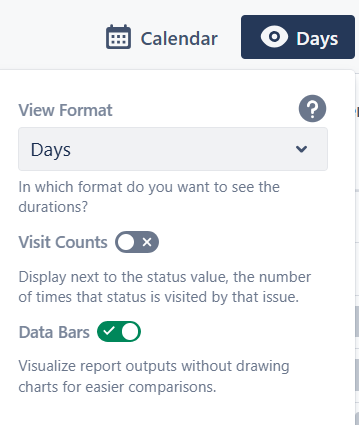
Bring Excel-Style Visualization to Jira
If you spend time in spreadsheets, you are likely already familiar with Excel’s data bar formatting. We brought that same visual utility directly into Timepiece.
When you enable Data Bars, a horizontal color bar appears in the background of each table cell. The original numeric value remains clearly visible as text over the bar, meaning you never lose access to your exact data.
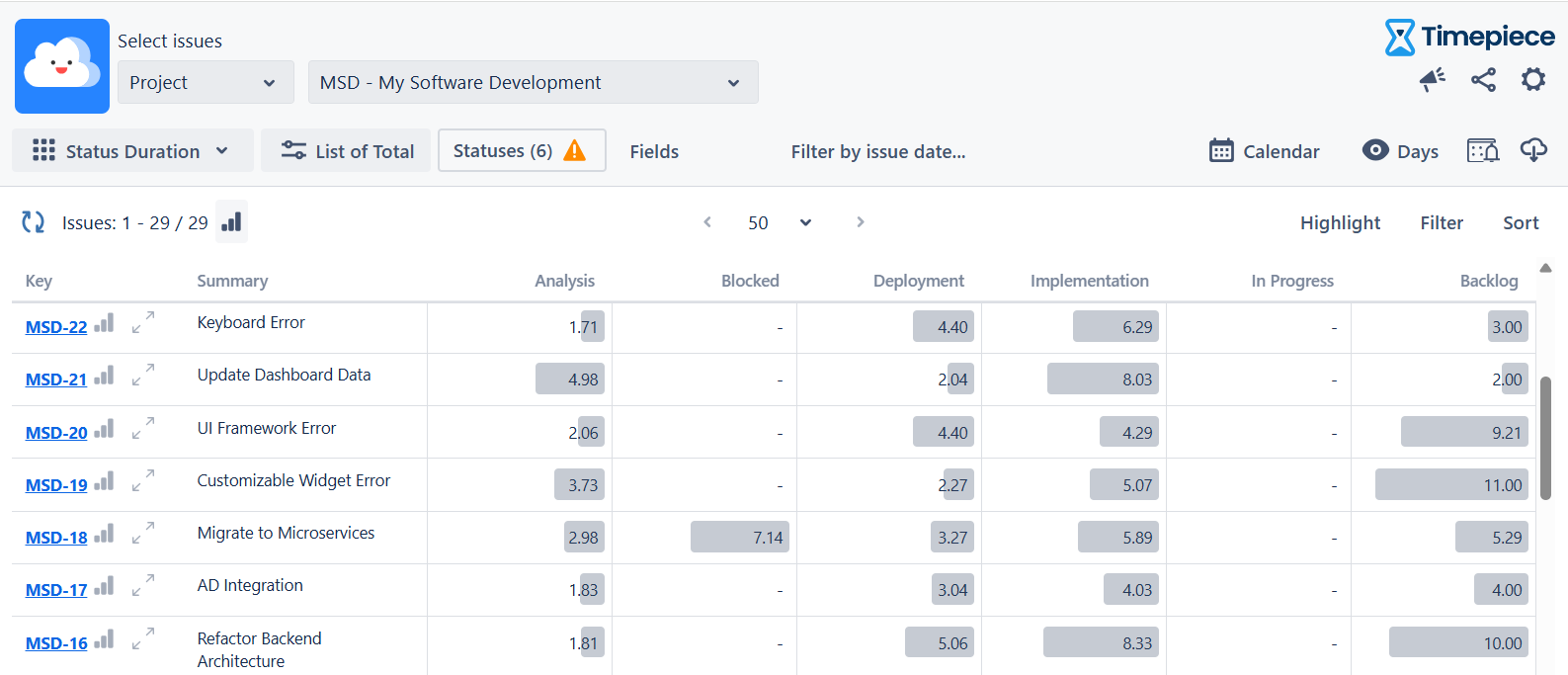
Instead of reading the numbers to find the longest duration, your eyes naturally gravitate to the cell with the longest bar. It is simple, highly effective, and drastically reduces the time it takes to digest a complex report.
How the Proportional Scaling Works
The length of each data bar is not arbitrary; it is dynamically calculated to give you immediate context. When the report loads, Timepiece identifies the single largest value currently displayed on the page. That maximum value becomes the 100% benchmark, and its cell is filled by the data bar. Every other cell on that page is then drawn proportionally to that maximum value.
For example, if the longest duration on your page is 100 hours, that cell gets a full bar. A cell with a 50-hour duration gets a bar that fills exactly half the cell. This relative scaling allows you to instantly see how individual issue durations compare against the worst-case outlier on your screen.
Explore Timepiece - Time in Status for Jira today, book a demo, or start your 30-day free trial.

New Feature: Scheduled Reports & Alarms for Timepiece – Time in Status for Jira

Time-Period Reports in Timepiece – Time in Status for Jira